Xecret: Stop shipping secrets in .env files
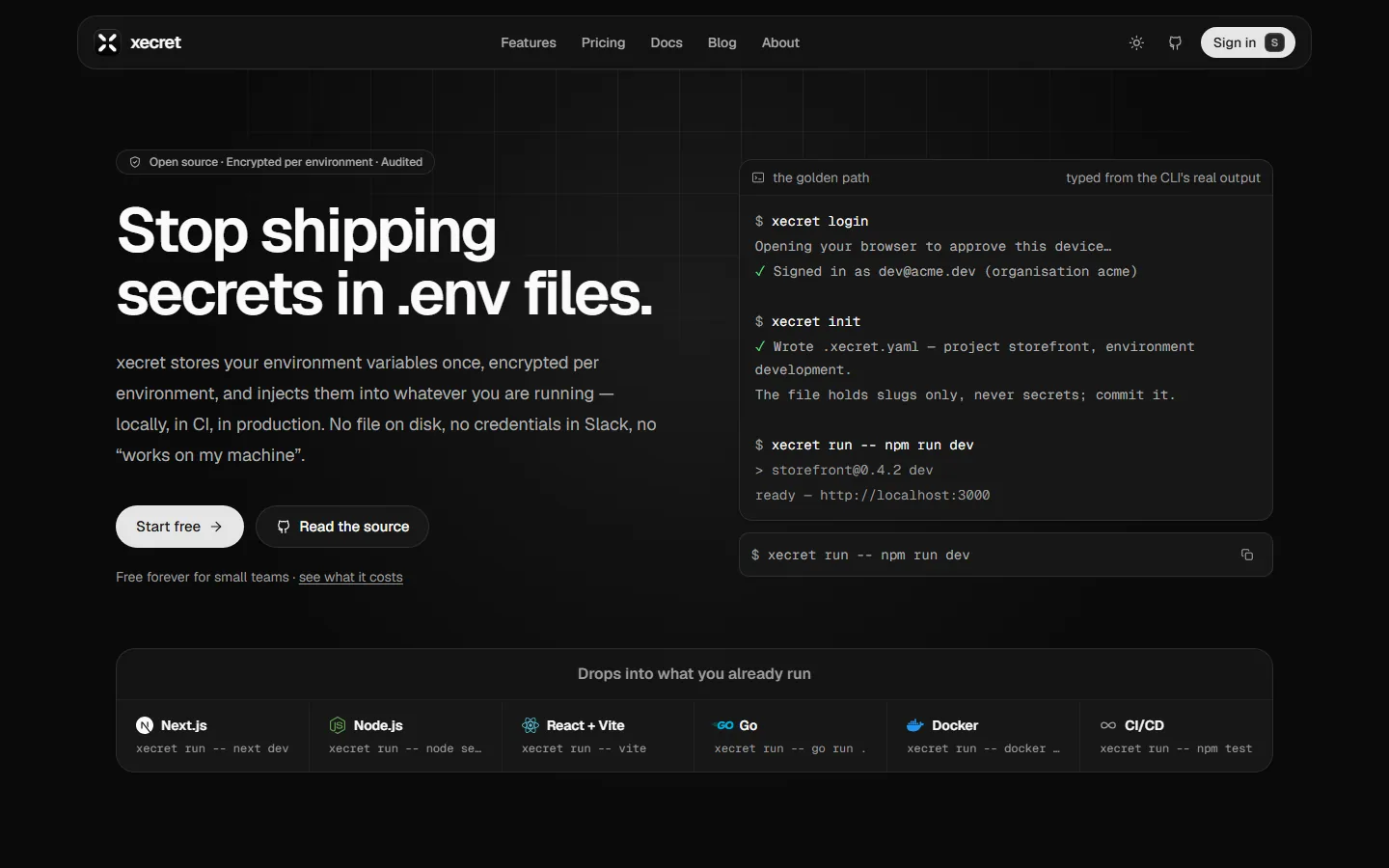
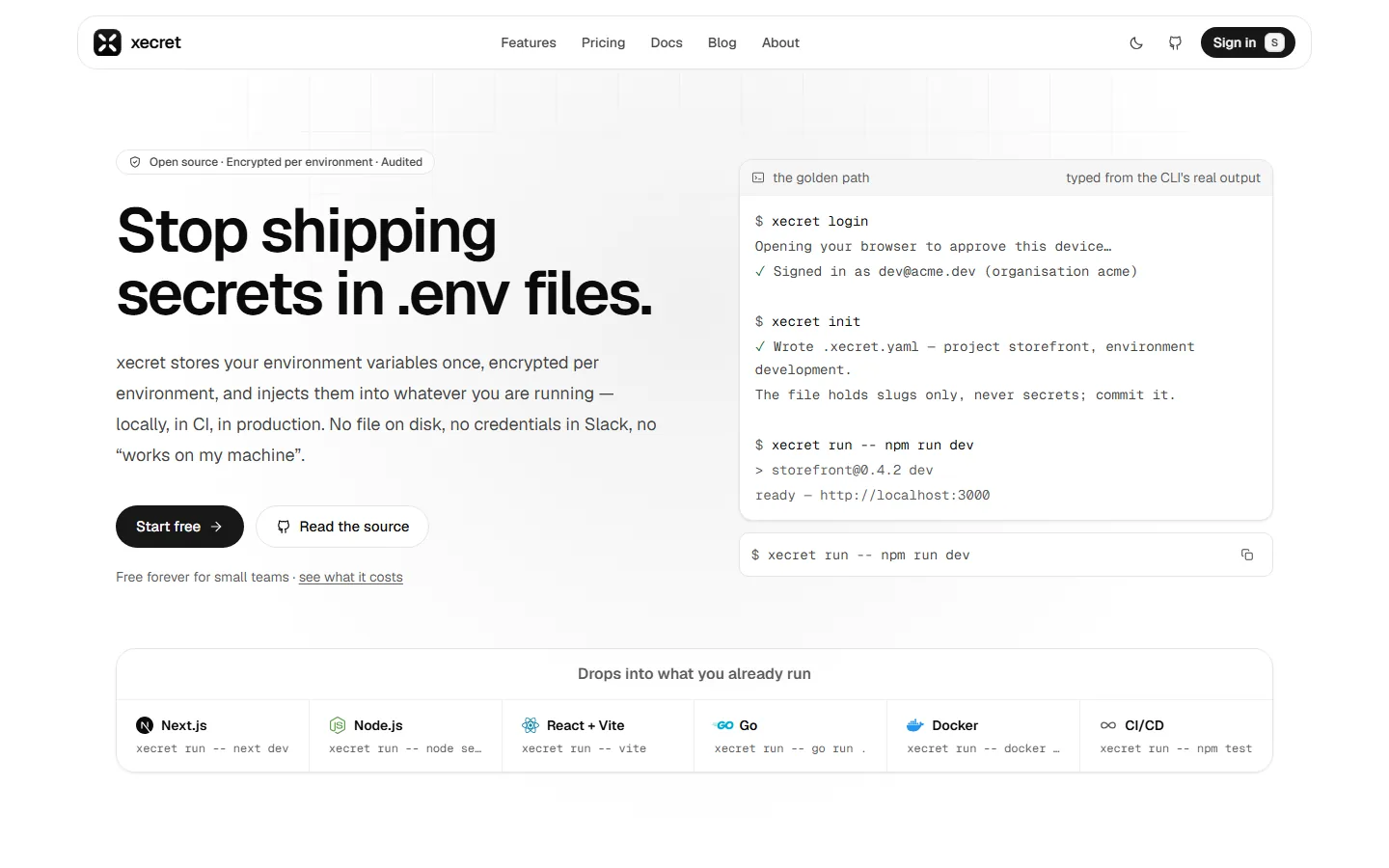
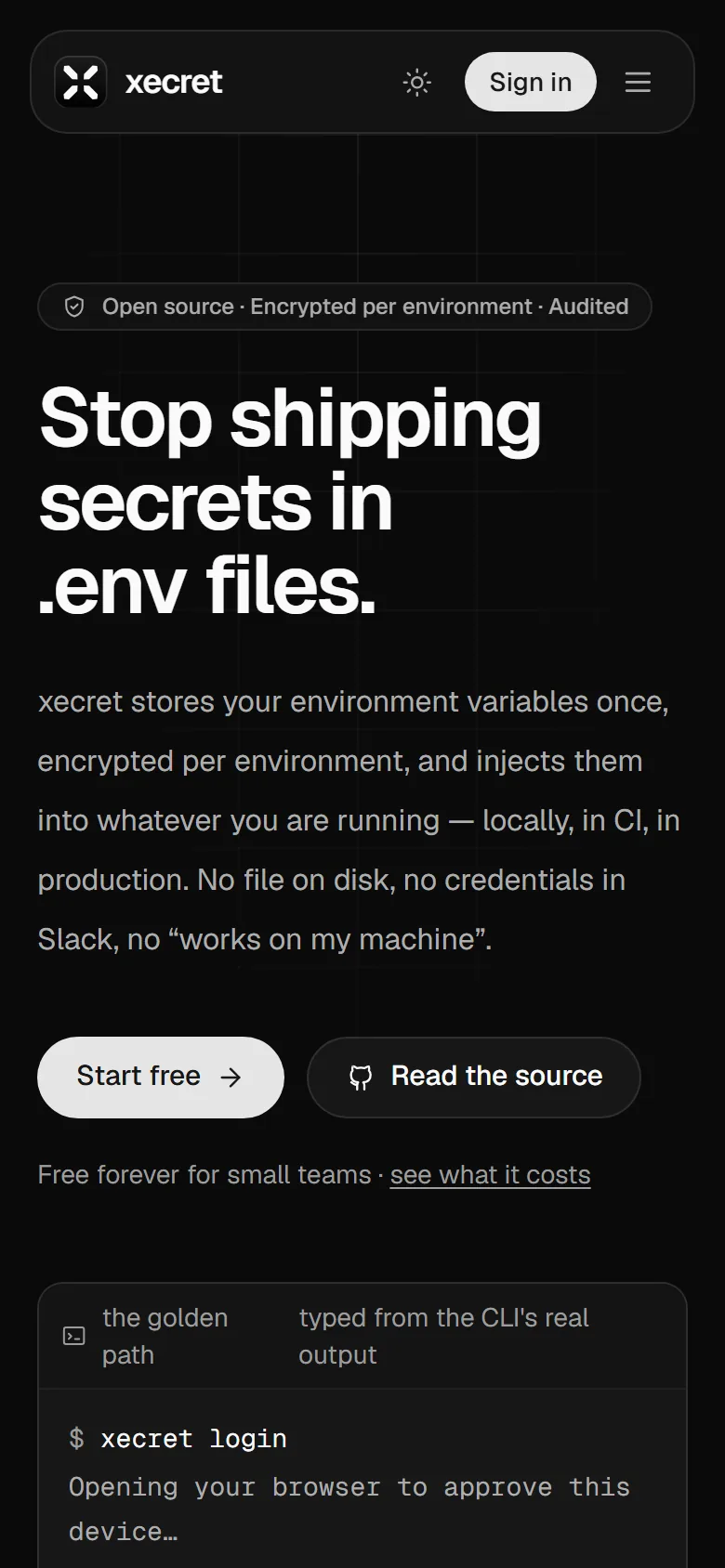
Open-source secret management — encrypted environment variables per stage, injected into your process with one command. No .env files on disk.
- Pre-alpha
- Web
- CLI
- Open source · AGPL-3.0 / MIT
- .env files on disk
- 0
- Forever plan
- Free
- Per member / month, billed yearly
- $5
- Self-hosted
- Unlimited
Overview
What is Xecret?
Xecret is an open-source secret manager for developers and teams, made by Playxoft. It stores environment variables once, encrypted per environment. One command injects them into your app, so no .env file sits on disk. The server is AGPL-3.0, the CLI is MIT, and self-hosting is free.
- One command, xecret run, injects secrets without a .env file on disk.
- Each environment has its own key, and every read is audited.
- Server AGPL-3.0, CLI MIT, self-hosting free with nothing held back.
The problem it solves
Teams pass .env files around in chat, and every copy goes untracked. Nobody can say who has one, whether it is current or what leaked.
Why Xecret
What makes Xecret different?
Stored once, encrypted per environment
Each environment gets its own data key, wrapped under an organization key and a root key. Staging ciphertext cannot be read with production's key.
One command replaces the file
xecret run fetches the environment and injects it into your process. Your code still reads process.env or os.Getenv.
An honest trust model
Xecret uses server-side envelope encryption, so the service can technically decrypt your secrets. If you need zero-knowledge, the docs tell you to choose another tool.
Features
What can Xecret do?
A Key Per Environment
Development, staging and production each hold their own encryption key — a leak in one never reaches the others.
One Command, Any Stack
`xecret run` injects secrets into Next.js, Node, Vite, Go, Docker and CI with zero code changes.
Append-Only Audit Log
An immutable record of who read which secret and when — ready for a security review.
Instant Revocation
Member and role-based access control where removing someone takes effect immediately, not at the next deploy.
Works Offline
An encrypted local cache keeps your dev loop and your builds alive through network outages.
Self-Host It Free
The AGPL-3.0 server runs on Cloudflare Workers with PostgreSQL (Neon recommended), with no feature held back.
Screens
Xecret in action
Real screens from xecret.playxoft.com. Pick a screen, or select it to see it full size.
01 / 05: Built for the way you work
How it works
How does Xecret work?
- 1
Create a project
Sign up with Google or email. Each project starts with development, staging and production, each with its own key.
- 2
Import your .env
Drag the file into the dashboard. It is parsed in your browser, with a dry-run preview before anything is sent.
- 3
Install the CLI and sign in
Run brew install playxoft/tap/xecret or npm install -g @playxoft/xecret. Then run xecret login and xecret init.
- 4
Run your app
Prefix your usual command: xecret run -- npm run dev. Delete the .env file and commit .xecret.yaml, which holds no secrets.
Who it's for
Who is Xecret for?
Built for
Solo developers
Stop syncing .env.example and pasting secrets between machines.
Small teams
Onboard with xecret login and xecret run instead of sending a file.
CI/CD pipelines
Service tokens scoped to one environment, read-only by default, free on every plan.
Teams guarding production
On the Team plan, developers get no production access until someone grants it.
- 01
Onboarding and offboarding
A new developer runs xecret login and gets only what their role allows. Removing a member stops every device they own at once.
- 02
CI/CD pipelines
Store a service token pinned to one environment as XECRET_TOKEN in your CI. Then wrap the build step in xecret run.
- 03
Docker images
Copy the static binary from ghcr.io/playxoft/xecret and inject secrets at runtime. They never land in an image layer.
Pricing
How much does Xecret cost?
Prices as published on xecret.playxoft.com, checked November 3, 2026.
Free
$0forever
For one developer who has had enough of moving .env files around.
- 1 organization, 5 projects
- 3 environments per project
- 3 members
- 10 service tokens for CI
- 7 days of audit history
Pro
$5per member / month, billed yearly
For a small team that has outgrown the free limits. $8 month to month.
- 25 projects across 3 organizations
- 10 environments per project
- Unlimited members
- 50 service tokens for CI
- 30 days of audit history
Team
$12per member / month, billed yearly
For a team with somebody who must not see production. $19 month to month, from 3 members.
- Everything in Pro
- Roles and per-environment access
- 100 projects, 5,000 secrets per environment
- 250 service tokens for CI
- 180 days of audit history
Enterprise
Custominvoiced, with an SLA
For organizations that need residency, their own root key and a contract. From 10 members.
- Everything in Team
- No ceiling on projects, environments, secrets or tokens
- Custom audit retention
- A commercial, non-AGPL self-hosting license
- A contractual SLA and a named contact
Self-hosted
Freealways
For anyone who would rather hold their own root key and run their own server.
- The whole server, under AGPL-3.0
- No feature held back, no license key
- Unlimited organizations, projects, members and environments
- Audit history for as long as your database keeps it
Good to know
What to decide before you start
It is pre-alpha
The encryption, audit log, CLI and self-hosting work, but there is no SLA yet. Paid features are on for everyone and no card is collected.
Server-side encryption, not zero-knowledge
The hosted service can technically decrypt your secrets. If your policy forbids that, self-host or pick a zero-knowledge tool.
Self-hosting has real dependencies
You need paid Cloudflare Workers, PostgreSQL, Secrets Store and a WorkOS account. Lose the root key and every secret is gone for good.
Under the hood
Designed, built and run by Playxoft
The same team builds web apps for clients. Need something like Xecret? We can scope it with you.
- Category
- DevTools / Secret Management
- Interface
- CLI + Web dashboard
- Compute
- Cloudflare Workers
- Database
- Neon / Postgres
- Encryption
- AES-256-GCM envelope, key per environment
- Status
- Pre-alpha
- License
- AGPL-3.0 server, MIT CLI
Xecret FAQ
Straight answers, checked against the live product on November 3, 2026.
Still have questions? Talk to our team
More from Playxoft
Other web apps we build


Need A Custom Solution?
Tailored To Your Exact Needs